
The Wobble Nobody Logged: What a Work-Order Close-Out Has to Capture

Somewhere on your site right now, someone knows about a problem your maintenance system doesn't. A technician heard a new noise or felt some play in a mounting. They mentioned it at shift change, wrote it on the whiteboard, or texted their supervisor. The asset's history in the system still says everything is fine.
Most of the time nothing comes of it. In October, Australia's transport safety investigator published a report on a time something did. It is a small incident with a minor injury, and it reads like a case study in what the record at the end of each job is for.
What happened on RTM Weipa?
On the morning of 23 June 2025 the bulk carrier RTM Weipa was at anchor off Gove, in Australia's Northern Territory. Down in the engine room, the first engineer and a trainee were doing planned work on the main engine. They were using the overhead gantry crane, a hoist that runs on rails near the ceiling, to move parts.
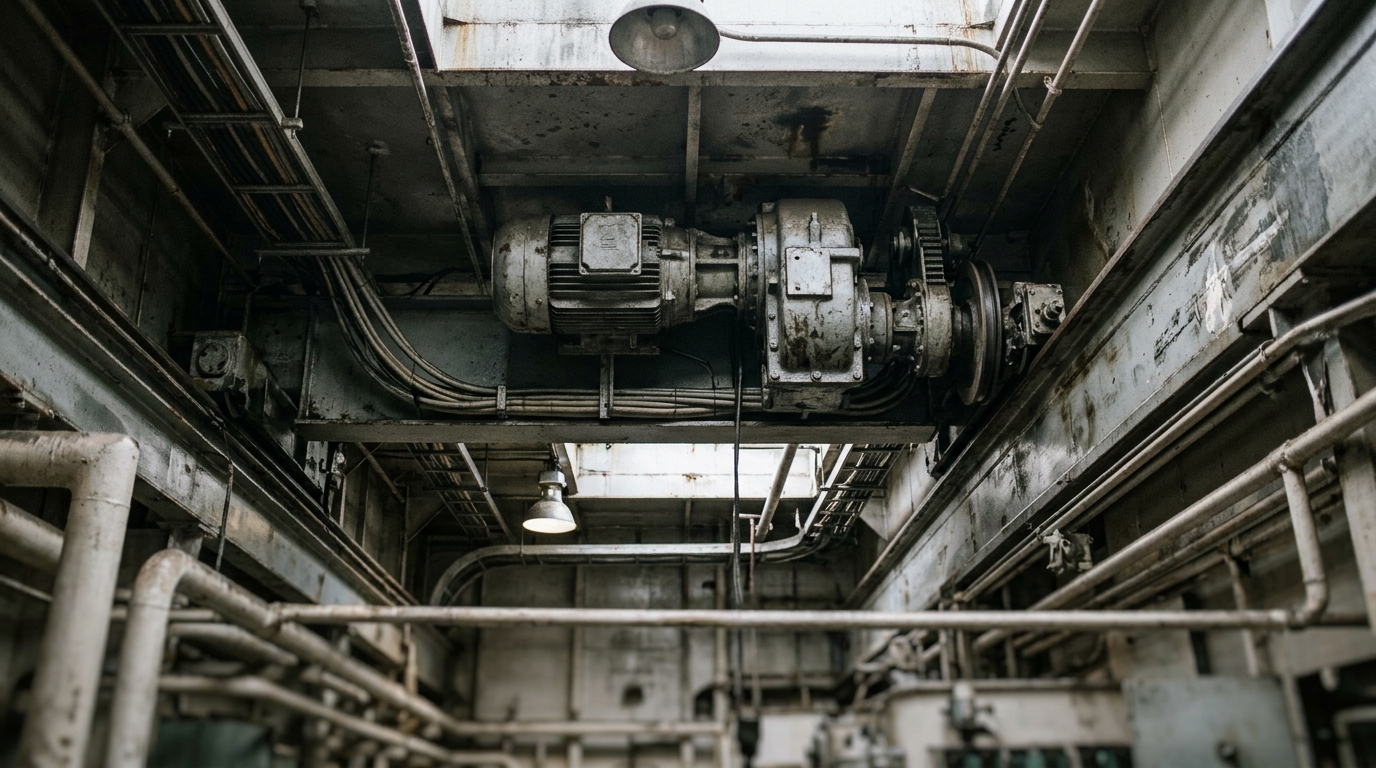
After one lift, with the crane standing still, its traversing motor came off its mounting. That is the motor that drives the crane along its rails, and it weighs about 25 kg. It fell about six metres into the work site. The trainee took a glancing blow and got away with minor injuries.
The Australian Transport Safety Bureau (ATSB), which investigates marine, rail and air accidents, traced the mechanism. Four small bolts held the motor to its gearbox. They sat inside the assembly, out of sight, and could only be reached by taking it apart. The manufacturer's manual didn't say they were inside or how to check them. Over time they worked loose and let go.
That is the engineering story. The part that matters to anyone running a maintenance function happened four months earlier.
Someone had already seen it
In February 2025 the first engineer wrote in his handover notes, the notes one engineer leaves for the next at crew change, that the traversing motor was "wobbly".
He didn't inspect it. The motor was high up and hard to reach, so he assumed a bearing inside it had collapsed. No spare bearing was ordered. The only copy of those notes kept aboard was an unsigned electronic file, and the office ashore had none. Later handover notes from both the first and chief engineers said nothing abnormal about the crane.
The wobble never went into the ship's planned maintenance system (PMS). That is the ship's version of the computerized maintenance management system (CMMS) or enterprise asset management (EAM) system you run on site: the place where defects are logged, work is assigned and parts are ordered. The company's own procedure said defects had to be entered there within 24 hours and reported ashore. In the ATSB's words, the wobble "was not properly investigated or reported", and the "personnel responsible for technical oversight of the crane were not aware of this anomaly."
Notice what did not go wrong. Somebody noticed. Somebody wrote it down. What failed was where the observation went.
What did the maintenance system say instead?
The PMS did have a task for the crane: inspect it every three months, traversing gear included. But the task, the ATSB found, "did not specify the nature of the inspection checks." It said inspect. It didn't say what to look at or what to write down.
The records show inspections in October 2024, January 2025 and May 2025, each with no defects or deficiencies recorded. When the motor fell, the system's defect list held eight items waiting to be closed out. None of them concerned the crane.
The report does not say the wobble was there to be seen at those inspections, only that nothing was recorded. That is the point. Anyone ashore reading the crane's history saw three clean inspections and no open defects. The record was tidy, and it told them nothing.
Nor was this a one-off. Going back through months of handover notes, the ATSB found other defects that belonged in the PMS and weren't there, on the rescue boat davit, the fuel oil system and the ballast water treatment system.
What does a record in the system do that a note can't?
The ATSB put the cost in one sentence. Keeping defects in handover notes "reduced oversight by other shipboard and shore-based personnel, and overlooked the PMS closed-loop functionality to track allocation of personnel and spare parts, and repair timeframes."
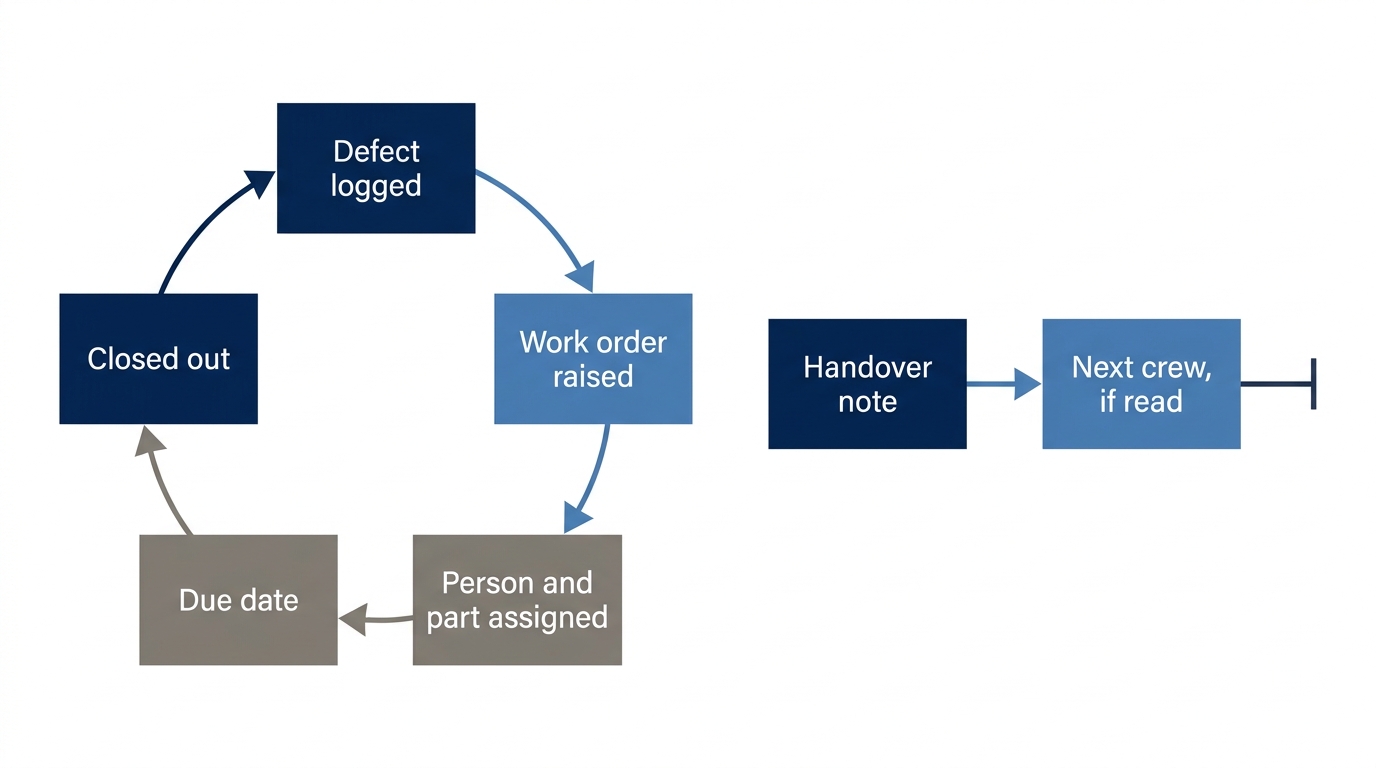
Closed loop is the phrase to hold onto. A defect entered against the asset raises work, gets a person assigned and a part ordered, carries a due date, and stays open until somebody closes it. A note does none of that. It sits in one person's file, gets read by whoever comes next if they read it, and is gone when the crew changes.
You don't need a ship for this to happen. Hodkiewicz and Ho, researchers who clean old work orders for reliability analysis, found that these records are often wrong or blank on where the asset is, how it failed and what was done, so analysts rebuild them from the free-text comments. In one published study of 386 work orders from a single company's CMMS, Salonen, Bengtsson and Fridholm found only 202, about half, carried a failure description good enough to use. That, they wrote, made eliminating root causes "impossible or very difficult at best."
What does a close-out have to carry?
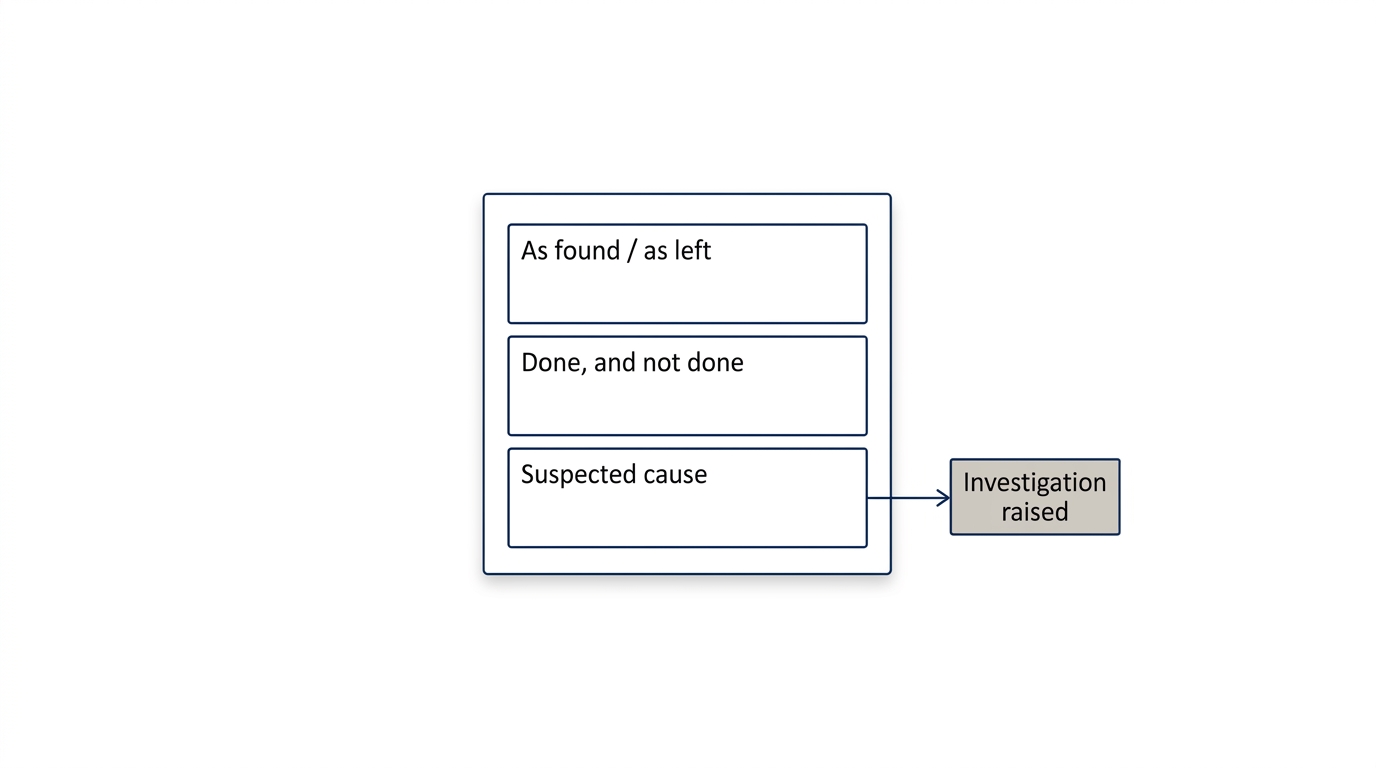
The close-out is the step where a work order is finished and the technician records what happened. It is the one chance to capture what was seen at the machine, by the one person who saw it. Reliability engineers, planners, finance and the next shift all read that entry later, and they have nothing else to go on. The RTM Weipa story shows three things a close-out has to carry.
What was found. Record the equipment's condition as found when the technician arrived and as left when they finished. NORSOK Z-008, a Norwegian standard for risk-based maintenance, lists "condition of equipment before and after maintenance" among the data that should be recorded as a minimum. On a preventive job this is the whole value of the visit. A record that says "no defects" proves someone signed. A record that describes the condition of the traversing gear, even as "good", gives the next reader something to compare against. None of this works unless the task says what to check. A job that says "inspect crane" will be closed as "inspected".
What was done, and what wasn't. Record the work in plain words. Record what couldn't be done too. "Not inspected, motor out of reach" is a finding. Entered against the crane, it would have raised its own work order for access.
The cause, left open. The engineer's collapsed bearing was a guess, and it stood in for an inspection. ISO 14224, the international standard for maintenance and reliability data, notes that identifying a failure cause "normally requires some in-depth investigation". Ask the technician what they saw and what they did. If they suspect a cause, record it as suspected and raise the investigation. Don't let a dropdown at the end of a shift close the question.
One check to run this month
Pick one asset class that matters to you: cranes, pumps, conveyors. Pull last quarter's preventive work orders for it and count how many record any as-found condition beyond "done" or "no defects". Then read the task instructions behind those orders and see whether they say what to check.
Next, ask your supervisors where crews actually write down what they notice. The whiteboard, the shift log, a group chat, a notebook in the workshop. Wherever that is, it is your real defect list, and your system has never seen it.
Our view: make the system the easiest place to write it down
After the investigation, the ship's manager, ASP Ship Management, retrained its crews fleetwide and told them handover notes "cannot replace the process of PMS defect logging". It built the defect process into crew briefings and shore audits, added a three-yearly crane overhaul task and fitted access platforms on all four sister ships. The crane's maker, Sekigahara Seisakusho, published monthly inspection procedures for the motor.
Most of that fix isn't about the crane. It is about getting what people see into the one place where the organization can act on it. That is the job of the close-out record, and it is why we would spend less effort adding fields to the close-out screen and more on two things: tasks that say what to check, and a defect entry that is quicker than a text message. If it's easier to tell a supervisor than to log a defect, crews will tell the supervisor, and your asset history will keep looking clean right up to the day it isn't.
Sources
- Australian Transport Safety Bureau, Crew injury in the engine room of RTM Weipa, 8 km from Gove, Northern Territory, on 23 June 2025, MO-2025-006, final report, 16 October 2026: https://www.atsb.gov.au/investigations/mo-2025-006 (PDF: https://www.atsb.gov.au/sites/default/files/documents/2026-10/MO-2025-006%20Final.pdf)
- Australian Transport Safety Bureau, Safety issue MO-2025-006-SI-01, "Defect reporting": https://www.atsb.gov.au/safety-issues/MO-2025-006-SI-01
- Australian Transport Safety Bureau, "Maintenance guidance updated after motor falls from gantry crane", 16 October 2026: https://www.atsb.gov.au/news/2026/guidance-updated-after-motor-falls-gantry-crane
- ISO 14224, definition of failure cause (note): https://cdn.standards.iteh.ai/samples/23088/c1be972f43494d5690a36bbec438dada/ISO-14224-1999.pdf
- NORSOK Z-008 (2024), Risk based maintenance and consequence classification, draft text, Table 3: https://nfv.no/wp-content/uploads/2024/10/NORSOK-Z-008_2024-Risk-Based-Maintenance.pdf
- Salonen, A., Bengtsson, M. & Fridholm, V., "The Possibilities of Improving Maintenance Through CMMS Data Analysis", IOS Press, DOI 10.3233/ATDE200163: https://ebooks.iospress.nl/pdf/doi/10.3233/ATDE200163
- Hodkiewicz, M. & Ho, M.T.W. (2016), "Cleaning historical maintenance work order data for reliability analysis", Journal of Quality in Maintenance Engineering 22(2), 146–163: https://research-repository.uwa.edu.au/en/publications/cleaning-historical-maintenance-work-order-data-for-reliability-a/
Get Insights by email
Each week we send new Insights articles and upcoming Resonance Group events to your inbox.
We use your address for the newsletter and nothing else, and you can unsubscribe from any email.