
Who Decides When the Asset Comes Offline

Is it just me, or does every asset-intensive organization run a version of the same meeting? A refinery calls it turnaround scope approval, a power station the outage scope freeze, a transit agency the allocation of track access, and a manufacturing site the weekly scheduling meeting where next week's maintenance is set against the production plan.
The question is the same in all four rooms, because the maintenance and inspection plan needs the equipment stopped, operations needs it running, and one side gets its way for another cycle.
Operations carries output, throughput, availability and on-time service, and asset management carries PM compliance, inspection coverage and backlog age. Neither set of numbers contains the other's constraint, so the meeting is where the conflict gets settled.
In most organizations it is settled against operations' criteria, written into the system as a work order with a later date, and never counted again.
The 2011 turnaround criteria at Chevron Richmond
Where are the admission criteria for that meeting written down? In refining they are, and the clearest public account of the decision comes from a refinery.
The U.S. Chemical Safety and Hazard Investigation Board's final report on the 2012 pipe rupture and fire at Chevron's Richmond refinery documents the turnaround Framing Document criteria, and documents them tightening. Under the 2007 document the approval team could admit an inspection or repair item needed to ensure ten years, two turnaround cycles, before the next inspection.
That criterion was deleted for 2011. The CSB records that the team in 2011 should refuse any work item for inspection, repair or replacement of equipment or piping unless it required a rate cut or shutdown within only five years, so a work item that would merely prevent a failure stopped qualifying.
The CSB found that the refinery's turnaround planning group rejected the recommendations to inspect or replace the section of piping that ultimately failed. A Chevron corporate review five months before the rupture found that critical inspection recommendations were being submitted to the shutdown planning process and were being denied.
The line failed on 6 August 2012 and released a hydrocarbon vapor cloud that engulfed 19 employees, six of whom suffered minor injuries, and about 15,000 people from the surrounding communities sought medical treatment in the following weeks.
So the analysis was done repeatedly across a decade, and each recommendation it produced stopped at a scheduling decision.
What does a deferred work order record?
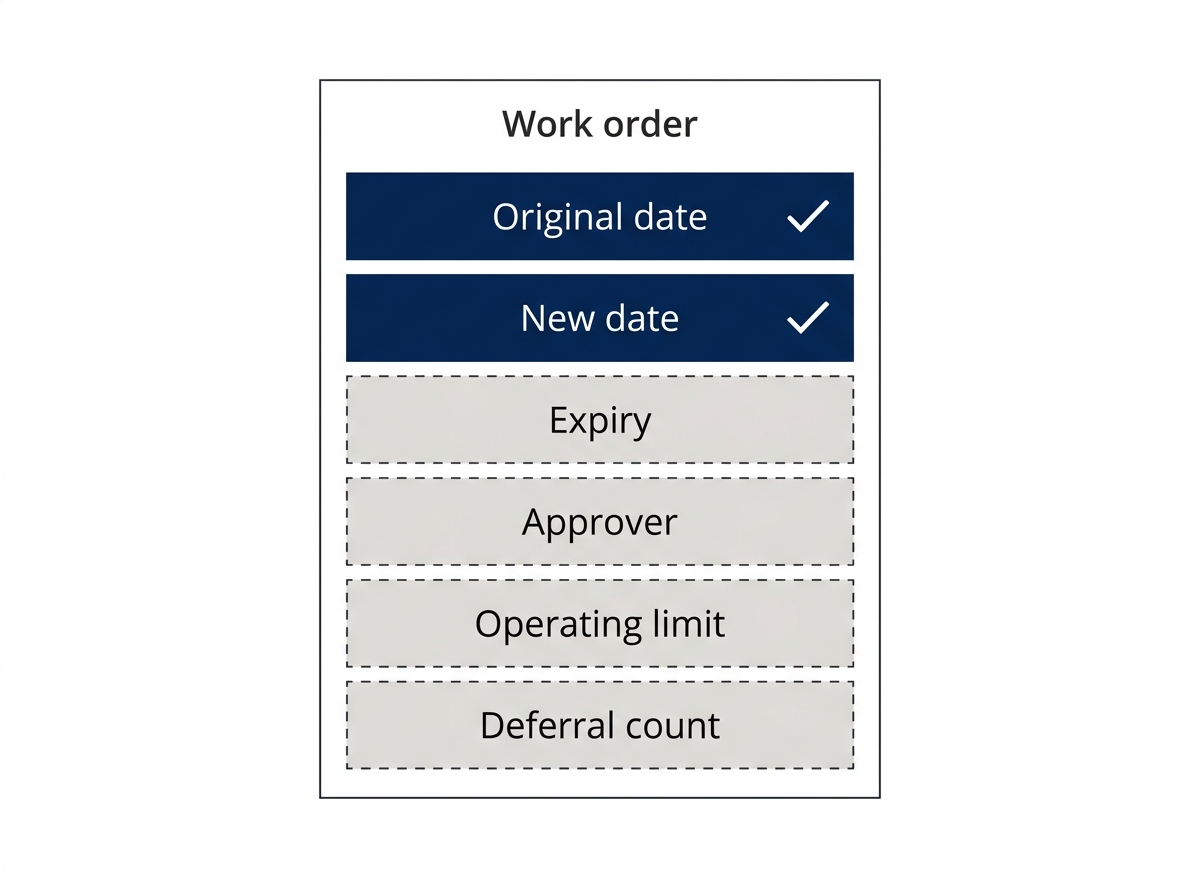
What happens to the request after the decision? It becomes a work order with a new date, and most practitioners will recognize what that record does not carry:
- an expiry, so the item can be deferred again at the next scope review and the one after
- a named approver, because the decision belongs to a committee and no individual owns it
- an obligation on the operating side, which gets the runtime and carries nothing new
- a total, because each deferral is one record edit and nobody sees the pattern until something forces a count
That describes a common configuration and what most readers have seen. No public dataset counts what EAM systems hold on a deferral.
One piece of external evidence points the same way, and it is an inference. The CSB recommended that a California refinery program require reporting of the technical rationale for any delay in work proposed but not yet completed. A regulator asking for that record is good evidence it was not previously visible, which is an inference from the recommendation and not something the CSB states.
Track access at WMATA in 2015
The Federal Transit Administration's 2015 Safety Management Inspection of the Washington Metropolitan Area Transit Authority found that increased demands for passenger service had shrunk the available maintenance windows, and that records showed up to 30 percent of planned maintenance work had to be re-scheduled for lack of track access.
That is one transit agency in one period, and it is not an industry rate. The same inspection found that the overnight window typically allowed between 90 minutes and two hours of on-track time.

Funding does not buy track time, so an organization can fund its capital plan fully, align it to asset condition, and still lose this work.
Between 1 January 2012 and 18 February 2015 the track and structures department issued 3,263 work orders for Priority 2 defects that remained open, and a follow-on FTA investigation logged 13,954 open track defects as of 1 May 2016, the earliest dating from 2008.
The minimum equipment list and the nuclear maintenance rule
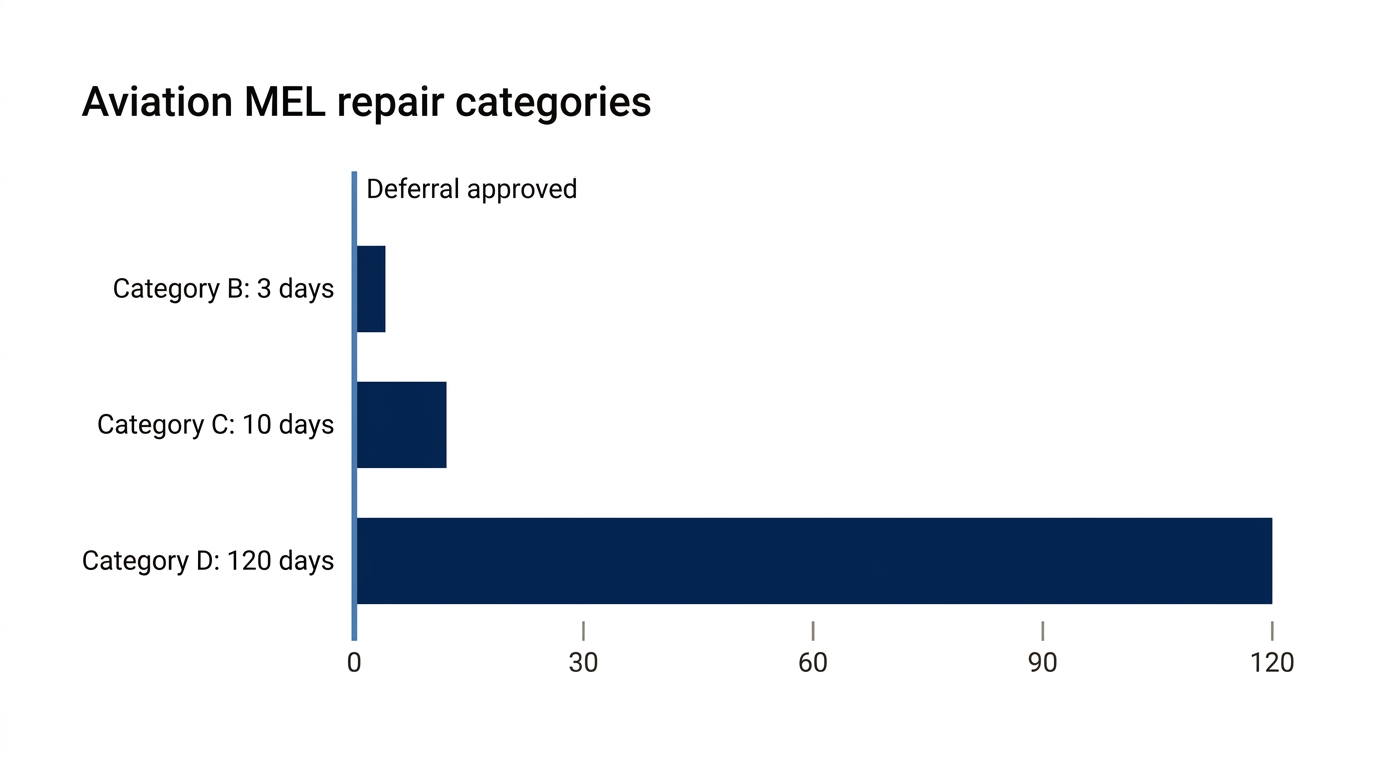
Has any regulator made an industry write this decision down? Aviation and nuclear power were both made to. Under 14 CFR 91.213 an aircraft may operate with certain equipment inoperative only under an approved Minimum Equipment List, and FAA guidance defines the repair categories as the maximum time interval during which an item may be inoperative. Category B is 3 consecutive calendar days, Category C is 10 and Category D is 120.
When an operator defers a repair, the aircraft may not be operated beyond the specified period until repairs are made. The FAA's (O) symbol marks an operations procedure that must be accomplished before operation with the listed item inoperative, carried out by the flight crew.
10 CFR 50.65(a)(4) requires that before performing maintenance activities the licensee shall assess and manage the increase in risk that may result from the proposed maintenance activities, which puts the operations risk assessment and the maintenance decision into one act.
Both regulators' first move was to give the deferral an expiry fixed in advance, an owner, and a procedure the operating side has to perform. Neither regime ports to a plant's PM backlog, though any organization can write those items into its own deferral record.
What do function assessments cover?
Operations can score well on everything operations is assessed on, and asset management can score well on everything asset management is assessed on, at the same site in the same year. The scheduling decision between them belongs to neither function's assessment scope, so neither examines it.
Scoring the operations and asset management pair
The Resonance Score measures a pair of disciplines on a 0 to 5 scale. It scores practice maturity on one side and system enablement on the other, reports the lower of the two as the score, and reports the gap as the Detuning, which shows which side to address first.
For this pair the practice side is what the scope decision has to state in writing and who signs it, and the system side is whether the deferral can carry an expiry, an owner and an operating limitation in the systems already installed.
Those systems are usually two, because the operations record and the asset management record sit in different products even when one vendor owns both. Octave Tempo Operations Management (formerly j5 Operations Management) documents control of work and shift handover, and Octave Attune EAM (formerly Hexagon EAM) holds the work orders and their dates.
A session runs on the systems already in place and recommends no replacement. If you want to see this in your own organization, start with the last scope list it approved, count the items that came off it, and check how many carry a date anyone is obliged to meet.
Sources
- U.S. Chemical Safety and Hazard Investigation Board, "Chevron Richmond Refinery Pipe Rupture and Fire, Final Investigation Report," Report 2012-03-I-CA, 28 January 2015. csb.gov
- U.S. Chemical Safety and Hazard Investigation Board, "Chevron Richmond Refinery Pipe Rupture and Fire, Interim Investigation Report," April 2013. csb.gov
- Federal Transit Administration, "Safety Directive 15-1, Public Transportation Safety Improvements for the Washington Metropolitan Area Transit Authority Metrorail and Metrobus Systems," 17 June 2015. transit.dot.gov
- Federal Transit Administration, "Final Report, Washington Metropolitan Area Transit Authority Safety Management Inspection," June 2015. transit.dot.gov
- Federal Transit Administration, "Final Report, Track Integrity Investigation, Washington Metropolitan Area Transit Authority," 8 August 2016. transit.dot.gov
- 14 CFR 91.213, "Inoperative instruments and equipment."
- Federal Aviation Administration, "AC 120-MEL, Minimum Equipment List." faa.gov
- Federal Aviation Administration, "AC 91-67A, Minimum Equipment Requirements for General Aviation Operations Under FAR Part 91." faa.gov
- U.S. Nuclear Regulatory Commission, 10 CFR 50.65, "Requirements for monitoring the effectiveness of maintenance at nuclear power plants." Text via Cornell Legal Information Institute, law.cornell.edu
- Octave, "Tempo Operations Management" and "Attune EAM" product pages. octave.com