
Three Certifications, One Blind Spot
Say your reliability engineers hold CMRP certification, your most recent ARC Advisory Group self-assessment landed at "Predictive," and your asset management system carries a current ISO 55001 certificate. On paper, you're mature by every standard measure the industry offers. But what do those three independent measurements really tell you about your organization?

Each one was built to answer a different question, so it pays to be precise about what those questions are. None of them asks the one question that decides whether your reliability program changes anything.
What each certification actually measures
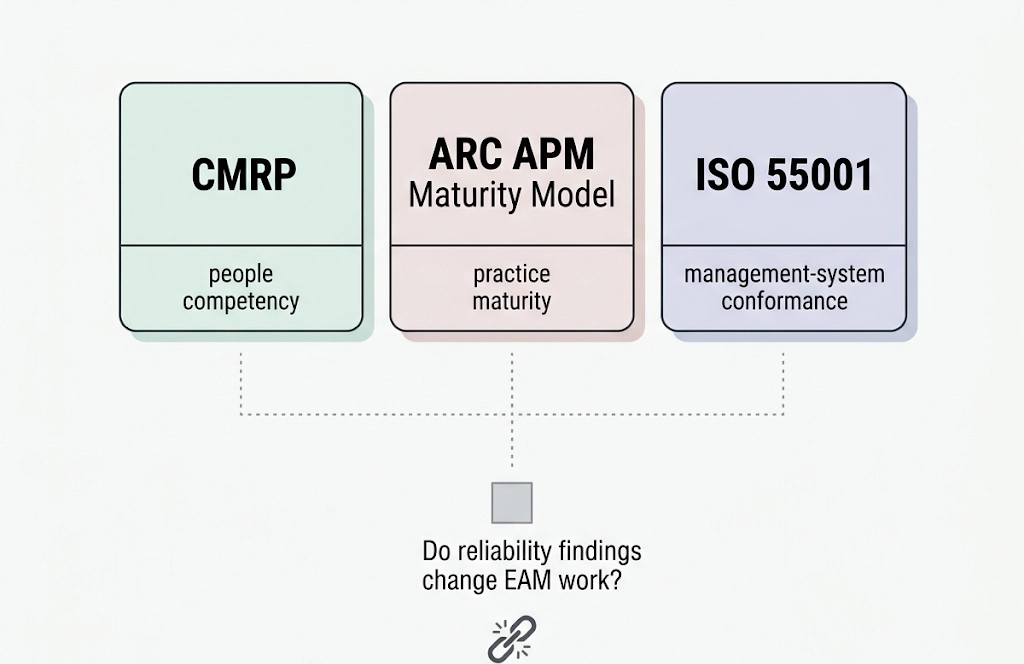
SMRP's Body of Knowledge rests on five pillars, and the CMRP exam tests an individual against all five of them. The pillars are Business & Management, Manufacturing Process Reliability, Equipment Reliability, Organization & Leadership, and Work Management. So when your engineers pass the exam, you've learned that your people are competent. How the organization around them behaves is a separate question, because a site can employ five CMRPs and still run its EAM the way it did a decade ago.
ARC Advisory Group's Asset Performance Management Maturity Model does look at the organization. It places your maintenance practice on a five-stage scale from Reactive to Prescriptive, based on whether work follows the calendar, asset condition, or a forecast. It stops at the practice, though, and never asks whether the software underneath is configured to support it.
ISO 55001 sits a level up again. It's a conformance standard, verified by external audit against a fixed set of requirements, and the Institute of Asset Management's own maturity model puts it in perspective. IAM anchors Level 3 of its six-level scale, "Compliant," to achieving ISO 55001, which places the certification at the midpoint with two stages still above it.
What none of them ask
So ask the question none of the three were built to answer. When your reliability team finds a pattern in the failure data, does anything change inside the system your maintenance crews work from every day? Does a PM task get rewritten, a condition threshold move, or a spare-parts stocking level get adjusted?
If the answer is no, none of your certifications will flag it. Individual competency, practice maturity, and management-system conformance are each scored on their own terms, and the connection between disciplines isn't on any of the three scorecards.
What this looks like in practice
Picture the organization that clears all three bars at once. The engineers are certified, the self-assessment says "Predictive," and the ISO certificate is current. Meanwhile, the RCM analysis reliability produces each quarter lives in a spreadsheet nobody in maintenance opens, the EAM's condition-monitoring module hasn't been touched since implementation, and the PM program running today is the same one that ran three years ago.
Would any of the three certifications catch that? They wouldn't, because none of them was designed to look for it. When practice and system are scored separately and never scored against each other, the reliability functionality inside the EAM ends up configured and idle.
What the Resonance Score measures instead
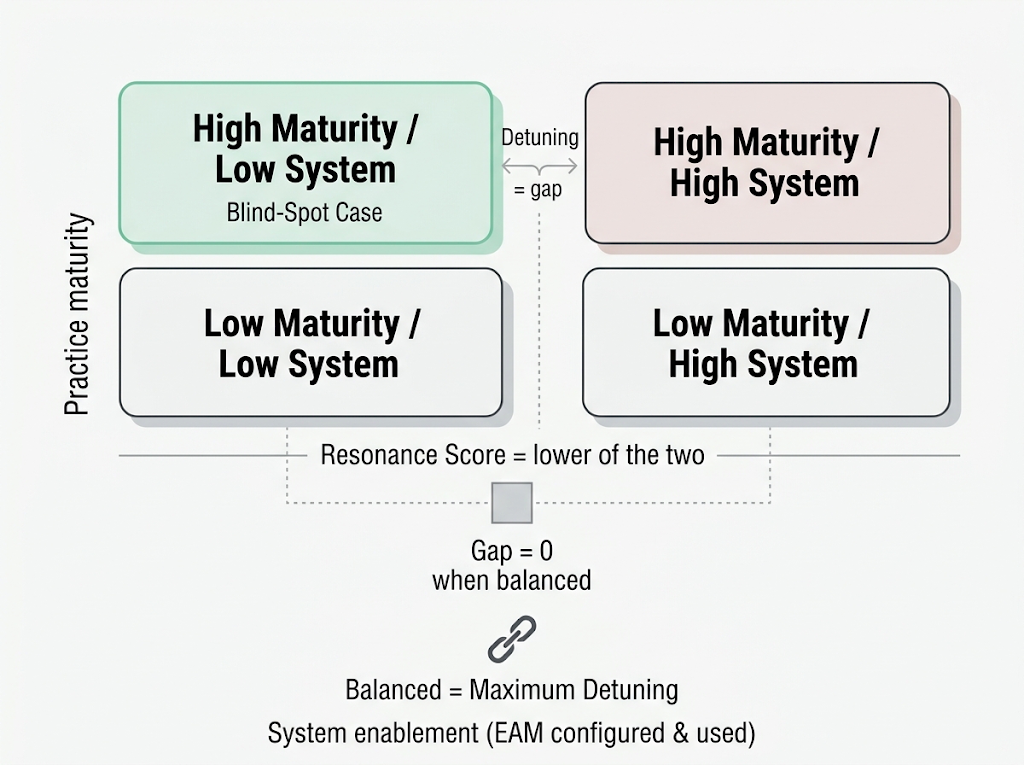
The instinct at this point might be to go looking for a fourth framework, one that rolls competency, practice, and conformance into a single number. But the gap we've been describing doesn't sit inside any one discipline. It sits in the relationship between two things that already have their own scores, and that relationship is what the Resonance Score measures.
For a pair of disciplines, it scores practice maturity on one side and system enablement on the other. It reports the lower of the two, because that's what the pair can actually deliver, and it reports the gap between them as the Detuning, which tells you which side to fix first.
If your reliability and work management functions already live on the same platform, as they do with Octave Attune EAM (formerly Hexagon EAM) or the wider Octave APM portfolio, the data needed to score that alignment is already in one place.
Keep your CMRPs, your ARC assessment, and your ISO certificate. Each one does a job worth doing. Then ask whether reliability's work changes what the EAM tells maintenance to do tomorrow, because that's the question a Resonance Score session for the maintenance-reliability pair is built around, and it will tell you which side of the gap you're standing on.
Sources
- SMRP, "Guide to the Maintenance and Reliability Body of Knowledge," smrp.org.
- SMRP, CMRP certification overview ("The CMRP Roadmap"), smrp.org/certification.
- ARC Advisory Group, "Asset Performance Management Maturity Model," arcweb.com.
- ISO 55001:2014/2024, "Asset management — Management systems — Requirements," iso.org.
- The Institute of Asset Management, "Excellence & Maturity," theiam.org.