
The Capital Plan Is a Forecast. The Asset Doesn't Know That.
In August 2022, flooding overwhelmed the O.B. Curtis Water Treatment Plant in Jackson, Mississippi, and left about 150,000 residents without reliable safe water for weeks. Reporting from NBC News, Brookings, Governing, NPR, and ABC News traced the collapse to decades of deferred maintenance and underinvestment in a system where some infrastructure predates the Great Depression.
Post-crisis capital-improvement estimates reached $1 billion or more. As of 2024 reporting, the system achieved regulatory compliance for the first time in over a decade under new management, JXN Water, with an October 2026 deadline to establish permanent governance.
The forcing event was flooding, but the pattern behind it shows up far beyond Jackson, in systems that have nothing to do with water. So here's the question worth asking about your own capital plan: how much of it is built from what your assets actually look like, and how much from what your finance system already had on file?
A capital plan describes a forecast. The asset only knows its own condition.
Why capital plans stay funded without staying accurate
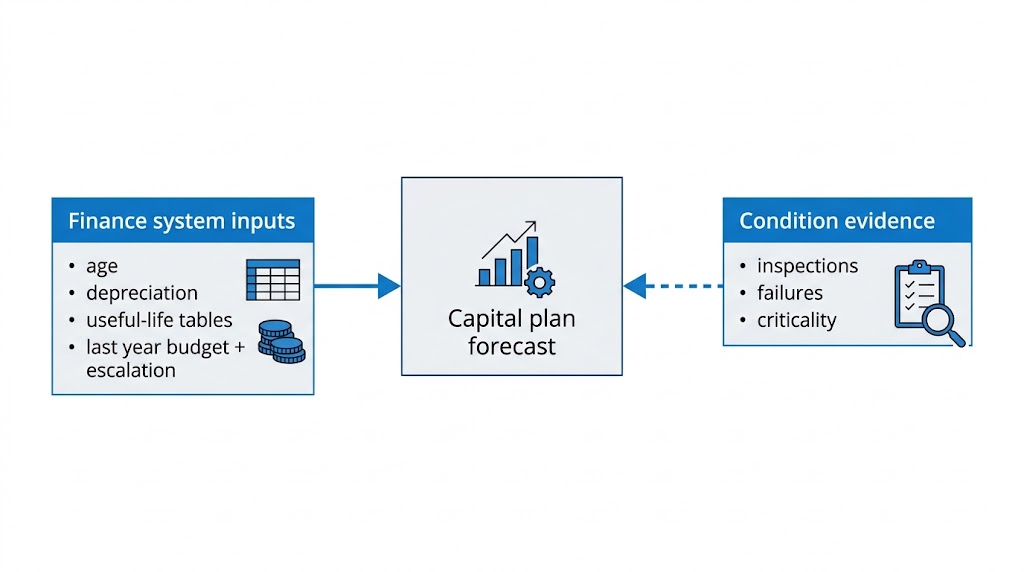
Where do the inputs to your capital plan actually come from? For most organizations, they're whatever is already on hand. Asset age, depreciation schedules, standard useful-life tables, and last year's budget plus an escalation factor all come from finance systems that already exist, on a timeline finance already runs.
Condition data lives somewhere else. Inspection findings, failure histories, and criticality scores sit inside the reliability function, and they rarely become a structural input to the capital plan, because the plan doesn't require them in order to close.
A plan built on age and escalation is forecastable and defensible on schedule. The budget cycle closes either way, whether or not the plan matches what an inspector would find in the field.
Why reliability's progress doesn't close the gap
Condition-monitoring technology has improved markedly over the past decade. Sensors are cheaper, criticality models are sharper, and reliability teams can say with real precision which assets are failing and roughly when. So why hasn't better condition data produced better capital plans?
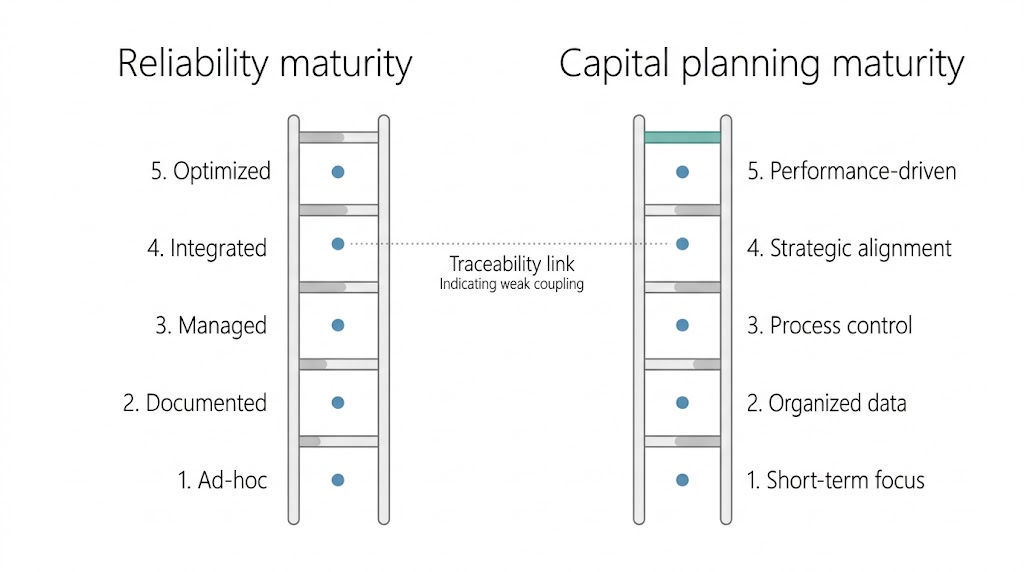
It hasn't, because the data was never the constraint. This is a discipline-pair problem, and reliability can advance on its own maturity scale while capital planning's ability to act on what reliability finds stays exactly where it was.
Each function can look sophisticated in isolation, and maturity models will score each discipline's internal sophistication on its own terms. Whether one discipline's evidence becomes a required, traceable input to the other's decisions is a question those models were never built to ask.
Two decades of the same finding
How long has this gap been documented? In January 2004, GAO reviewed how federal agencies including the VA, the National Park Service, the Bureau of Prisons, and NOAA used asset inventories and condition data to inform capital investment. It found limited success translating that data into funding decisions and recommended that the Office of Management and Budget require agencies to comply with its Capital Programming Guide.
Two decades later, the same gap shows up at a far larger scale. Deferred maintenance and repair backlogs across the Department of Defense and federal civilian agencies more than doubled, from $171 billion in fiscal year 2017 to $370 billion in fiscal year 2024, according to GAO Director David Marroni's April 2025 testimony to the House Appropriations Committee.
GAO added federal building condition to its 2025 High-Risk List, and the General Services Administration separately reported in March 2025 that its own deferred maintenance backlog exceeded $17 billion. GAO's language for what happens next is specific. Deferred assets require premature replacement, which costs significantly more than maintaining them on schedule.
The gap widens even as conditions improve
The clearest evidence that this is a discipline-alignment failure comes from the American Society of Civil Engineers. Its 2025 Infrastructure Report Card gave U.S. infrastructure an overall grade of C, the highest since the report card began in 1998 and up from a C- in 2021.
At the same time, ASCE's projected gap between currently planned investment and what's needed for good repair through 2033 grew to $3.7 trillion, up from $2.59 trillion in the 2021 report. How do conditions improve while the funding gap widens in the same four years? Better monitoring moved the grade, and the planning side kept drifting on its own schedule.
Water and transit show the same pattern
The EPA's seventh Drinking Water Infrastructure Needs Survey, published in September 2023, put the 20-year capital improvement need for the country's drinking water systems at $625 billion, or $629.1 billion including tribal systems. The need for replacing aging distribution and transmission pipe alone rose from $310 billion to $421 billion compared with the prior 2018 survey.
Transit shows a similar shape. The Federal Transit Administration's most recent state-of-good-repair backlog analysis, using 2022 data, put the national transit asset backlog at $140.2 billion, about 10 percent of the $1,338.4 billion total asset replacement value, up from $101.4 billion in 2018.
Inflation and newly added assets explain part of that increase. The remainder is infrastructure that kept decaying while reinvestment didn't keep pace with what its condition already showed.
What the updated standard is starting to require
ISO 55001, the asset management systems standard, is being updated. The 2024 edition replaces the 2014 version, and certified organizations must transition by July 31, 2027.
According to summaries of the update from ISO consultancies, the new edition adds a clause on asset management decision-making that would require organizations to document the criteria, process, and delegation behind their asset decisions. The prior 2014 edition reportedly let organizations score well on paper without ever showing that their capital decisions traced to condition evidence.
If that reading holds, the new clause asks something maturity scores never did. Did one discipline's findings become a traceable input to the other's decisions?
What maturity scores don't check
The Institute of Asset Management's self-assessment scores organizations on a six-stage maturity scale running from Innocence to Excellence, a framework used across the industry. It scores each discipline on its own, with no check on the connection between them.
The market has started to notice that condition data and capital planning have historically lived in separate systems. Verdantix now publishes a distinct research category, "Smart Innovators: Asset Investment Planning Software," evaluating vendors specifically in that space.
Measuring the connection itself
None of this means your reliability team or your capital planners are doing their jobs badly. Both can score well on everything they're measured against and still produce a plan that drifts from the asset for years, because nothing in either discipline's own maturity work requires the two to check against each other on a routine basis.
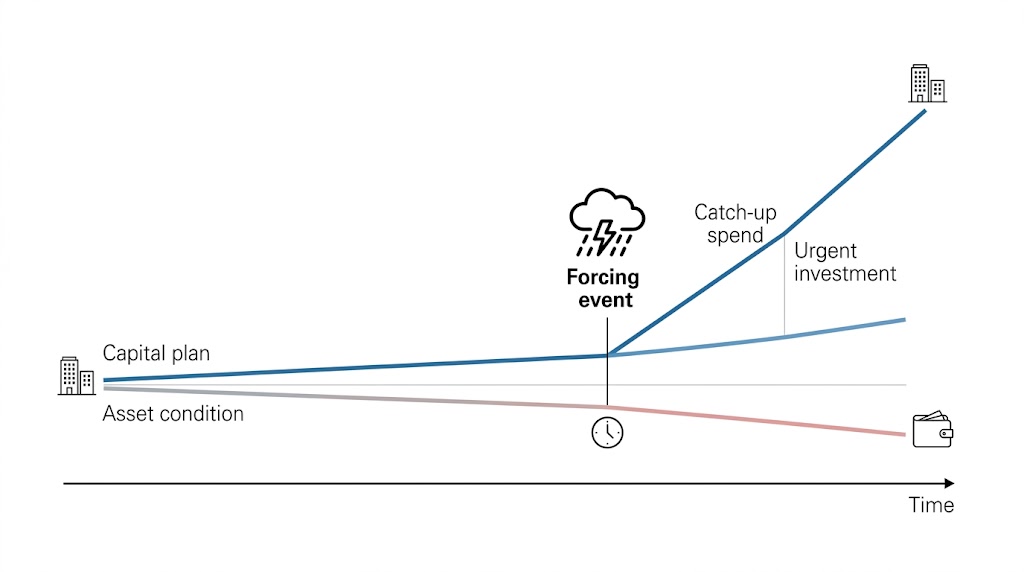
So who does that checking in your organization today? For most, the honest answer is the forcing event. It might be a failure like Jackson's, an audit, a rating action, a change in leadership, or a funding request that finally gets scrutinized. Whichever it is, the catch-up it triggers always costs more than steady, condition-informed reinvestment would have.
The alternative is to treat the link between capital planning and reliability as something to measure and manage in its own right, on the same schedule as each discipline's separate maturity work. A Resonance Score session for that pair scores practice maturity on one side and system enablement on the other, then reports the lower of the two, plus the gap between them as the Detuning. That gap tells you which side to address first, while the choice of where to start is still yours to make.
Sources
- NBC News, Brookings, Governing, NPR, and ABC News reporting on the Jackson, Mississippi water crisis, 2022-2024.
- GAO, testimony of David Marroni, Director of Physical Infrastructure, before the House Appropriations Committee, April 9, 2025.
- GAO, 2025 High-Risk List, gao.gov.
- U.S. General Services Administration, deferred maintenance backlog reporting, March 2025.
- GAO-04-138, January 2004, gao.gov.
- American Society of Civil Engineers, "2025 Infrastructure Report Card," March 2025, infrastructurereportcard.org.
- EPA, "Seventh Drinking Water Infrastructure Needs Survey and Assessment," September 2023.
- Federal Transit Administration, State of Good Repair backlog analysis, January 2025 (2022 data), transit.dot.gov.
- ISO, secondary consultancy summaries of the ISO 55001:2024 update, iso.org.
- The Institute of Asset Management, self-assessment maturity scale, theiam.org.
- Verdantix, "Smart Innovators: Asset Investment Planning Software," verdantix.com.