
The Pump, the Rebuild or the Duty? Why Your Attune EAM Setup Decides Whether You Can Ever Tell

A pump comes back from the rebuild shop, goes into service, and fails again within months. The shop says operations is running it too hard. Operations says the rebuild was poor. The vendor suggests a newer model. Then the capital planner asks the question that actually costs money: do we keep rebuilding these, or replace the lot?
Most plants can't answer that with evidence, because the records were kept against the slot the pump sat in, not the pump.
A Canadian safety report published last month shows, in unusual detail, what it takes to settle this kind of argument. It's an aviation case, not a plant, and we use it here only as an analogy. But the reasoning maps directly onto a decision every Octave Attune EAM (formerly Hexagon EAM) customer makes early in implementation, usually without the people who later live with the result.
What happened to the engine in the Kelowna report?
On 2 March 2023, a WestJet Encore Dash 8-400 climbing out of Kamloops, British Columbia, with 74 passengers and 4 crew, lost its No. 2 engine. A blade on one of the engine's compressor rotors (a spinning disc of blades that squeezes air before it is burned) cracked and broke. A fire followed in the exhaust duct. The crew shut the engine down and landed safely at Kelowna. Nobody was hurt.
The Transportation Safety Board of Canada (TSB), the independent accident investigator, released its final report on 22 September 2026.
The rotor that failed was new, fitted when the engine was last rebuilt in March 2022. It had run 909 cycles (a cycle is roughly one flight) of the 20,000 it was allowed: under 5% of its life.
How did investigators tell a bad part from a bad rebuild from a bad duty?
They asked the three questions your reliability engineer asks about that pump.
- Was it a bad part? No. Metallurgists found "no metallurgical anomalies" where the crack began. The metal was sound.
- Was it a bad rebuild? Partly. During the rebuild, the gap between the blade tips and the casing was reduced. It stayed within specification, but it let the engine run at higher speeds.
- Was it a bad duty? Mostly. "Duty" means the conditions the equipment runs under. Flight data showed that a fuel-saving setting the airline used during climb pushed the engine into a narrow speed band, around 26,000 rpm, where the blades vibrate in resonance. Very cold air, below −25 °C, made that vibration stress 2.5 times worse. After the rebuild, the engine spent more time in that band.
The fix was not a better part. On 15 May 2024 the airline changed its operating procedure so crews keep the standard setting until the top of the climb. The engine maker, Pratt & Whitney Canada, used fleet data to flag higher-risk engines, and inspecting them found two more cracked rotors.
Investigators could do all of this because the records kept three things apart: the aircraft, the engine in the No. 2 slot, and the individual rotor inside it, each with its own serial number and its own history. The report even lists earlier failures of this rotor type, each by serial number, at anywhere from 1,225 to 12,812 cycles. A scatter like that says this isn't simple wear-out, and you only see it when every unit carries its own count.
Aviation rules require that kind of record for parts like this one. In a plant, nobody requires it. Someone chooses it, or doesn't.
What does that look like at a pump in your plant?
A 2019 paper from the Prognostics and Health Management (PHM) Society, a professional body for reliability engineers, put the plant version in one sentence: "If failures or performance is not tracked against both the serialized asset and the lowest level of the functional location, it is extremely difficult to determine if a recurring issue is associated with a particular location or a poorly-rebuilt asset."
"Functional location" is the industry term for the slot: the place in the process where a job gets done, whatever unit happens to be doing it. Attune EAM calls it a position.
Attune EAM keeps two kinds of record, arranged in a hierarchy, the parent-and-child tree that shows what sits inside what (a position holds an asset, and positions sit under larger systems and locations).
- A position is the function. Octave's Help describes it as something "which can be filled by any number of actual, physical pumps."
- An asset is the physical unit with its own serial number. The Help calls assets "the base unit of equipment information and the smallest tracking unit for capital investments."
When a work order (the record of a repair or inspection job) is written against an asset, Attune EAM also stores that data on the position the asset sits in. So you get both views at once.
The Help's own example mirrors the TSB case. Pump PU-9476-96 fails in position PUMP-03 and is replaced by pump PU-4854-93. The first pump is repaired and installed in another position, PUMP-02. Because both pumps and both positions hold history, you can compare two pumps in the same slot, and one pump across two slots.
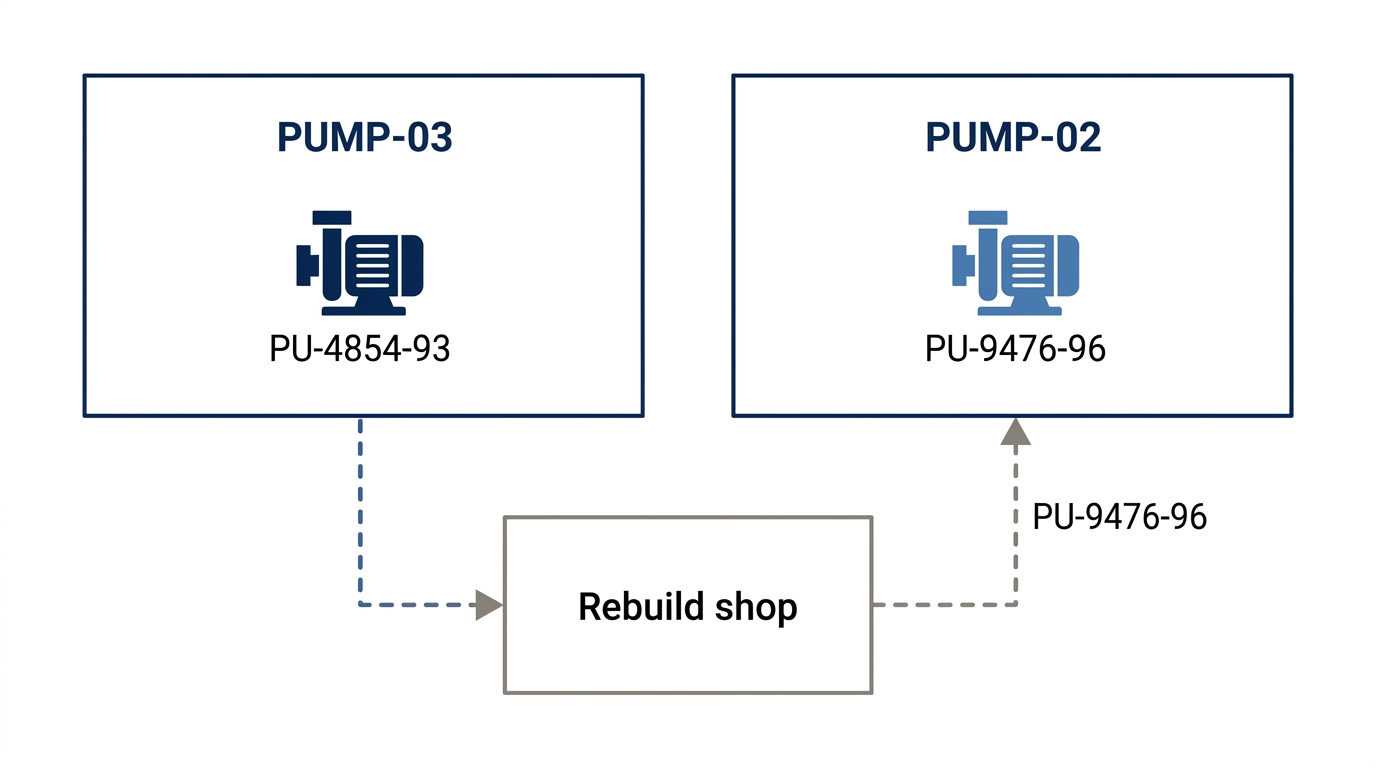
Together, those comparisons are the part-versus-duty test. If a pump fails early wherever it goes, suspect the pump or its rebuild. If every pump fails early in PUMP-03, suspect the duty.
What does Attune EAM leave for you to decide?
Attune EAM doesn't decide which equipment gets its own asset record. Octave's equipment hierarchy feature brief calls the hierarchy "the most important decision you will make regarding the implementation," and gives a clear rule: "Only create an asset if it will be tracked… If you have no intention of moving the asset, do not create one. Just creating the position is sufficient."
That rule is sound. Equipment that never moves gains little from an asset record, and every extra record is one more thing to keep accurate.
The trouble starts when a swappable pump, one that goes out for rebuild and comes back to a different slot, gets set up as a position only. Then every failure is logged against the slot. You see that PUMP-03 keeps failing, but not which unit was in it, whether it had just come back from the shop, or whether it failed the same way elsewhere. You're back to three people with three theories, and a capital planner deciding from an average.
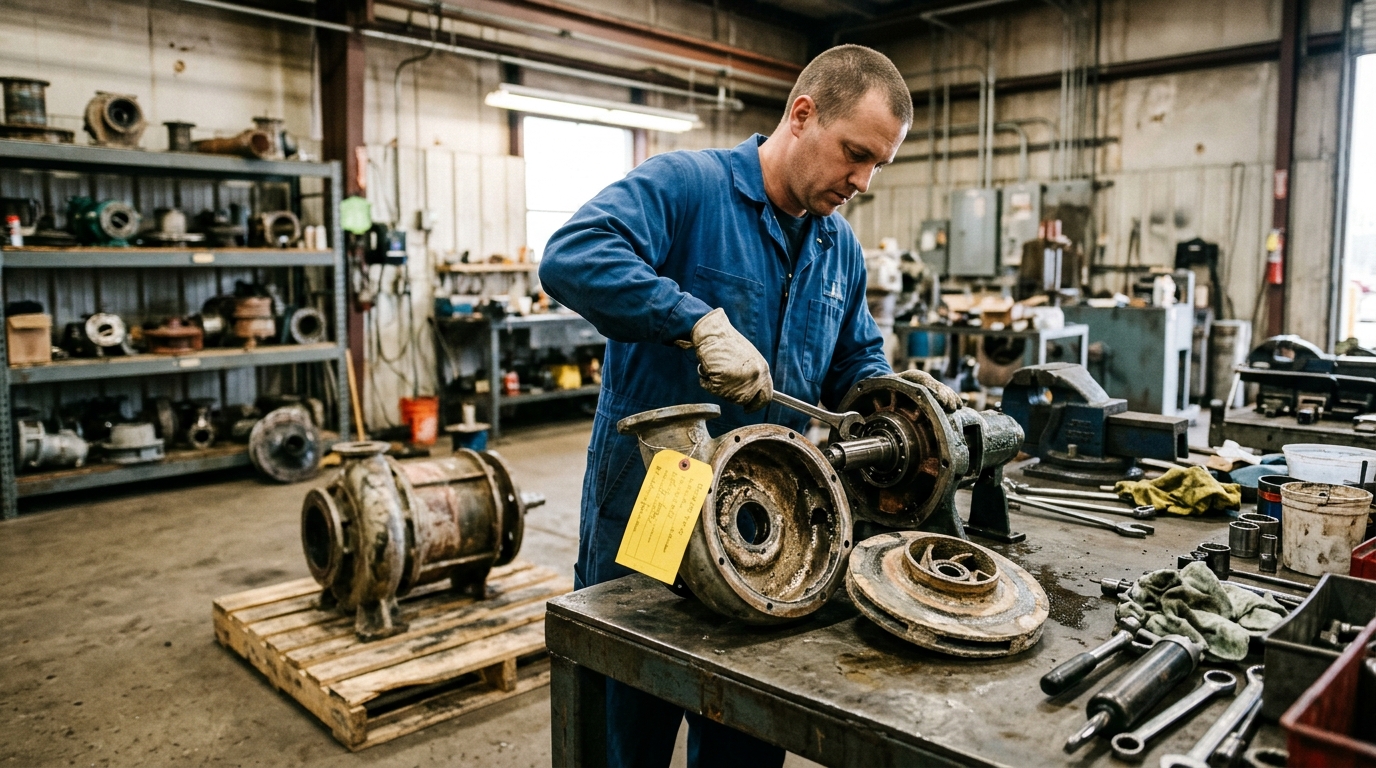
The same gap carries into the storeroom. Attune EAM can follow a repairable unit through the shop and back by serial number, including the worn unit, or core, you send off for rebuild, but only if it exists as its own record. A position-only pump has no identity to follow through the repair loop.
Where are the limits?
First, the software records a judgment; it doesn't make one. Which equipment gets tracked as an asset is an engineering and commercial call.
Second, analysis tools inherit whatever the hierarchy gives them. Octave Attune APM (formerly HxGN APM) is Octave's asset performance management product, used to analyze failure modes and choose maintenance strategies. It receives work order, maintenance, cost and failure data from Attune EAM. If that history sits on positions only, APM sees the same blind spot your engineers do.
Third, the analogy has edges. Unit history did not save that aircraft; the crew did. And the TSB report says nothing about maintenance software.
Who should be in the room when the hierarchy is designed?
Octave's brief names its own readers: "capital planners, buyers, and operations managers who need to make decisions regarding the replacement of capital assets." They pay when swappable equipment is left as a position only, usually years after the implementation team signed the hierarchy off.
The Kelowna case shows why operations belongs there. The root cause was an operating choice, a sensible fuel-saving setting in a manual, and its cost landed on the equipment. Operations and maintenance were out of step, and nobody could see it until operating data was joined to the history of individual units. That is our reading, not the TSB's, but plants will recognize it.
What does a sound setup look like?
- A position for every function you maintain, as the stable anchor.
- An asset for anything that ever goes to the shop and comes back, including repairable spares in stores.
- No asset for equipment that never moves.
- Written reasons for every exception, so the next team knows the choice was deliberate.
- Depreciation agreed with finance. Finance keeps its own depreciation records, so agree before go-live which records carry it.
Why the history is the part you can't get back
A badly built hierarchy can be restructured later.
The history can't be fixed. If a swappable pump spends its first five years as a position only, no restructuring will tell you which unit sat in that slot each time it failed. The evidence that would have settled the rebuild-or-replace argument was never written down.
Our view: treat this as a capital-planning decision, not a configuration task. Put purchasing, reliability, operations and capital planning in the hierarchy workshop, go through the list of pumps, motors and other rotating equipment line by line, and create an asset from day one for everything that will ever leave its slot. It means more records to maintain. Skipping it means that years from now, a capital planner asks a fair question and gets a guess.
Sources
- Transportation Safety Board of Canada, Air Transportation Safety Investigation Report A23P0020 (released 22 September 2026). https://www.tsb.gc.ca/eng/rapports-reports/aviation/2023/a23p0020/a23p0020.html
- Octave Attune EAM Help, "Understanding equipment." https://docs.hexagonppm.com/r/en-US/Octave-Attune-EAM-Help/12.3.1/1260608
- Hexagon, HxGN EAM Equipment Hierarchy feature brief. https://docs.hexagonppm.com/go/HxGN-EAM-Equipment-Hierarchy/12.3
- Saetia, K., Lukens, S., Pijcke, E., Hu, X., "Data-driven Approach to Equipment Taxonomy Classification," Annual Conference of the PHM Society, 2019. https://papers.phmsociety.org/index.php/phmconf/article/download/818/phmc_19_818
- Octave, Octave Attune EAM (formerly HxGN EAM) product page. https://www.octave.com/products/asset-performance-management/attune/eam
- Octave, Octave Attune APM (formerly HxGN APM) product page. https://www.octave.com/products/asset-performance-management/attune/apm
Get Insights by email
Each week we send new Insights articles and upcoming Resonance Group events to your inbox.
We use your address for the newsletter and nothing else, and you can unsubscribe from any email.